
The Thing – I know I’m Human
Read Time: 8 mins
Film: The Thing (1982)
Director: John Carpenter
Starring: Kurt Russell, Keith David, Wilford Brimley, T.K. Carter, David Clennon, Richard Dysart, Charles Hallahan, Peter Maloney, Richard Masur, Donald Moffat, Joel Polis, Thomas Waites
Soundtrack: Ennio Morricone
Genre: Sci-Fi, Horror, Body Horror
Over forty years since its theatrical release, John Carpenter’s Antarctic elegy to paranoia and social atomisation feels less like fiction than an omen. In our post-truth moment, Kurt Russell’s MacReady proclaiming “I know I’m human” feels fundamentally unverifiable. The film is haunted by suspicion and by the instability of truth itself. Though undeniably shaped by Cold War anxiety, The Thing now feels less historical than diagnostic, holding up a mirror to our own world of kayfabe logic, where the truth must be performed and tested.
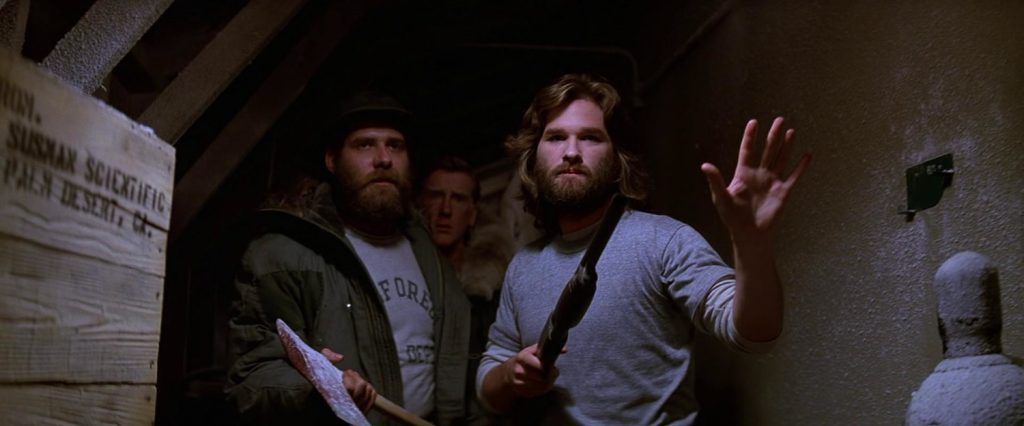
_ Fun in the dog house
Originally released in 1982, The Thing — a reimagining of 1951’s The Thing from Another World and John W. Campbell’s novella Who Goes There? — was, by all accounts, both a critical and box office failure. It’s rare to see a film travel from “the most hated film of all time” (Cinefantastique) and “disappointing” (Roger Ebert) to being routinely cited as one of the greatest science-fiction horror films ever made, which it is, obviously.
It’s been a tempestuous few weeks here. Floods, gales, closed motorways — an unwanted lockdown flashback, only this time in a much, much smaller flat. Confined to bed, some mystery virus coursing through my veins, it seemed as good a time as any to load up the DVD player, open a jotter, and add my voice to the ever-growing chorus of podgy middle-aged men on the internet insisting that Jon Carpenter’s The Thing is indeed a cultural masterpiece.
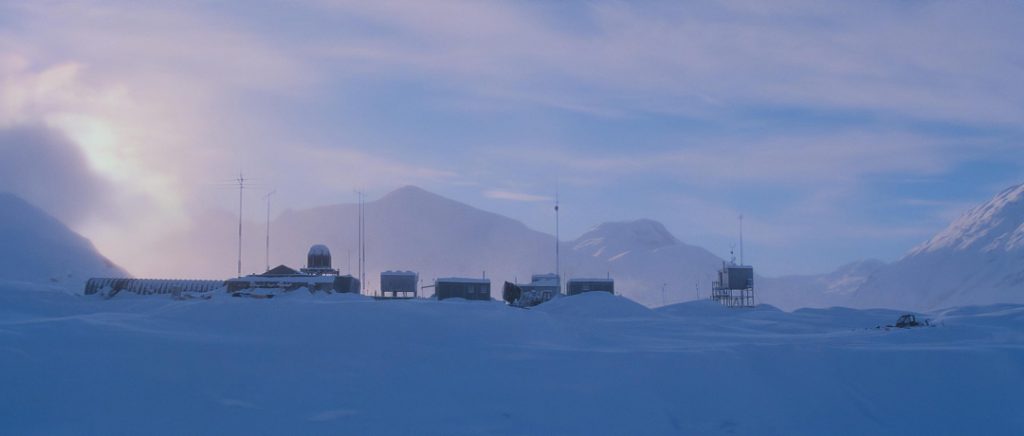
Before we reach the Antarctic research station, Carpenter presents us with a sequence of disorienting images: ominous synths drone as a UFO hurtles toward Earth, burning up in the atmosphere, ushering in a single staccato synthesised bass note as we open onto a vast glacial wilderness. A Norwegian helicopter appears to be hunting one of the most beautiful wolfhounds ever to grace celluloid (RIP, goodboy Jed, 1977–1995). What cruelty is this? Who could do such a thing? From the outset, Carpenter encodes the film with confusion, paranoia, and icy detachment, while Ennio Morricone’s soundtrack sharpens the tension — a score so effective it’s hard to believe it once won a Razzie. The tension escalates further as the wolf finally reaches the research station, the helicopter crashes, and the Norwegian’s warning — screamed in Norwegian, of course — is cut short along with his life by Garry’s gunfire.
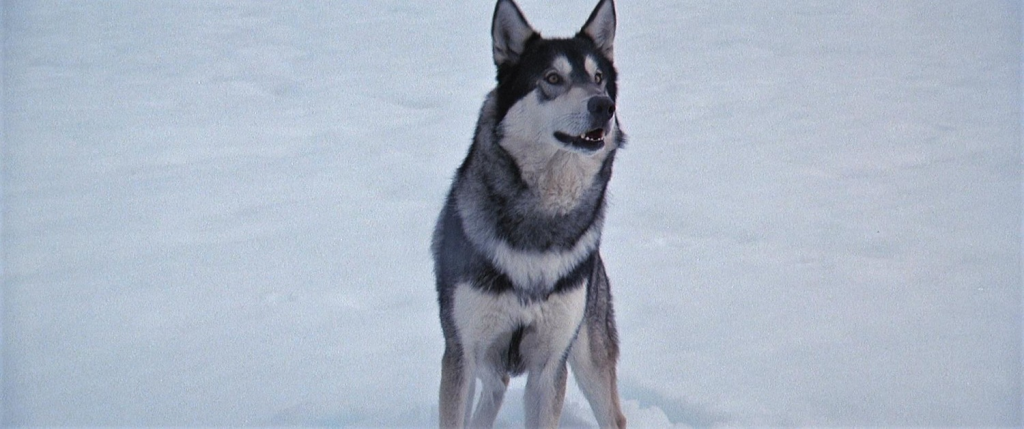
_ Goodest boy, Jed (also star of White Fang)
This sense of mistrust, miscommunication and foreboding is the spinal fluid running through the film’s core. Like The Shining before it, the cold and desolation do much of the psychological legwork. The characters — none of whom seem to be friends, and all of whom are male — are enclaved in this polar outpost. A place detached from everything, where nothing is real, and prerecorded game shows serve as entertainment. Where isolation amplifies suspicion and hierarchies ossify.
And into this ring of male ego and emotional detachment steps pilot R. J. MacReady, armed only with a sombrero, a bad attitude, and a helicopter licence — a man so cocksure that, when checkmated by the autonomous chess computer, Chess Wizard (coincidentally the only female presence in the entire film), his response is to pour a glass of whisky into its disk drive before calling it a “cheating bitch” — hardly boyfriend material.
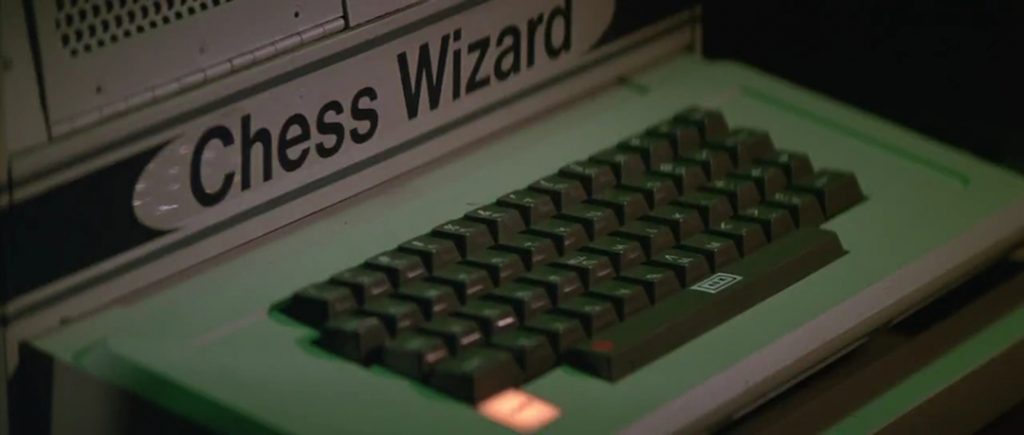
_ "Cheatin' Bitch!"
This is a world where selfhood is precarious, where even the smallest tell can spark suspicion, where evil is essentially viral. Though the film oozes with utterly nauseating practical effects courtesy of Rob Bottin, we never truly witness the Thing in its essence; we only see its process, it’s a happening, not a Thing, and that is where the true horror lies. As in Lovecraftian horror, Carpenter never fully reveals the monster. Yes, we know it can mimic lifeforms down to the last cell; we see the viral modelling on Blair’s monitor, but we are never granted confirmation of how deep that mimicry truly goes. There are clues that it runs very deep indeed.
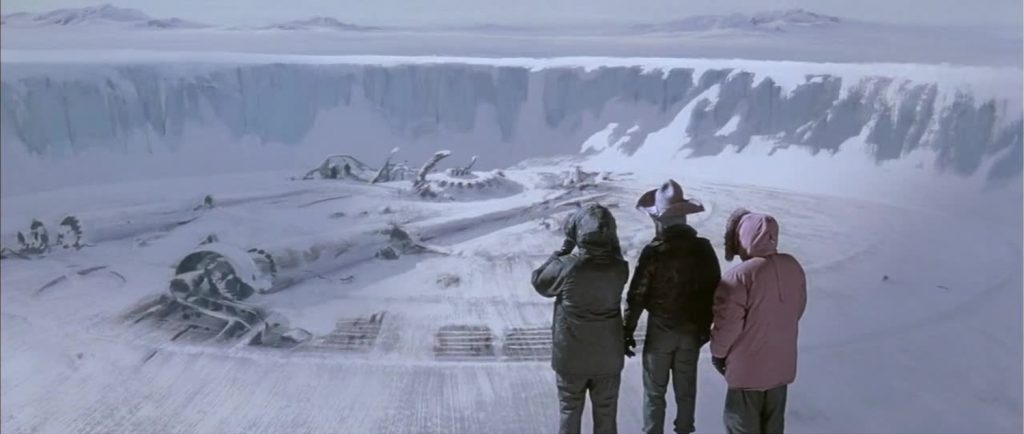
_ The original crash site
For example, toward the end of the film, what remains of the crew discovers a partially built spacecraft buried beneath the shack that has become Blair’s prison. By this point, it is clear that the microbiologist has long since been assimilated. Still, his sudden ability to construct a functioning escape vehicle suggests something even more disturbing: the Thing does not merely replicate — it remembers. If so, then Blair is no longer simply some evil alien; he is an accumulation — alien intelligence layered with wolfdog instinct, Norwegian expeditionary knowledge, human scientific expertise, and who knows what else. Does Blair even know he has been assimilated? Is the alien that initially crashed even the original monster or just another victim?
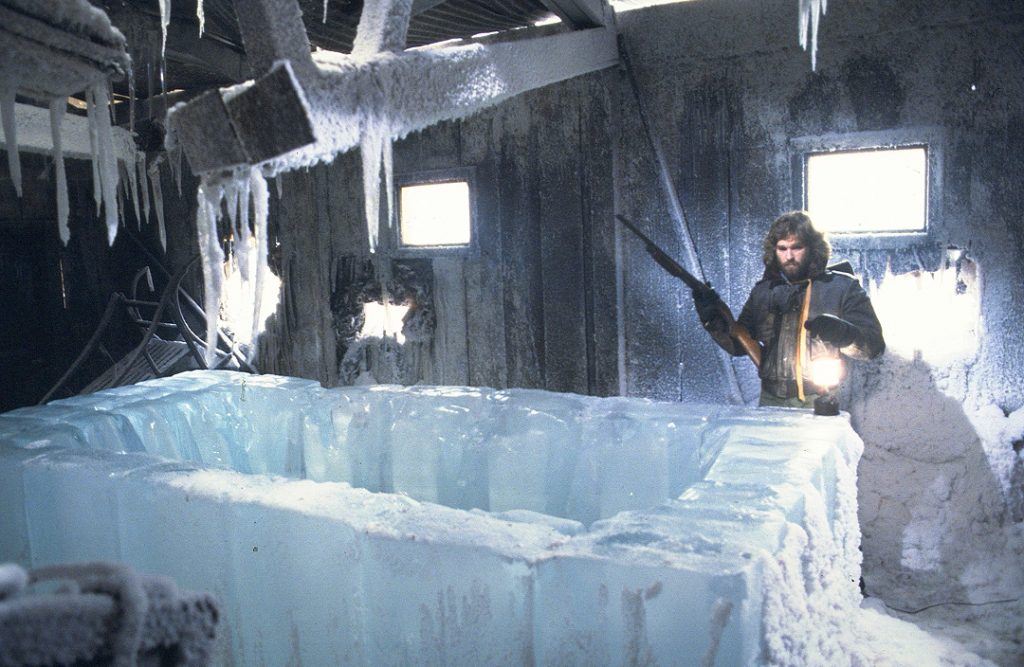
_ Trip to the Norwegian Camp
In the harsh tungsten light of the research outpost, we are condemned to question everything, including ourselves. Faced with this reality wobble, MacReady does what strongmen like MacReady do: he tells a story. Not to himself, but to the others — a narrative delivered as fact.
When Childs asks:
“So, how do we know who’s human? If I was an imitation, a perfect imitation, how would you know if it was really me?”
MacReady responds with certainty:
“I know I’m human… If you were all these things, then you’d just attack me right now… This thing doesn’t want to show itself; it wants to hide inside an imitation.”
A persuasive argument, perhaps — certainly the others seem convinced. But it is nothing more than bluster: a performance of authority even when all evidence points to the contrary. We already know the Thing can be anything in that room. The horror is not that MacReady might be wrong; it is that he has no way of knowing whether he is right. But he asserts it anyway. His worldview cannot entertain uncertainty — and the group responds in kind. This reflex toward dominance has them following his lead, even when he is no more justified here than he was when accusing the chess computer of cheating. Control must be asserted, even if everything else goes up in flames.
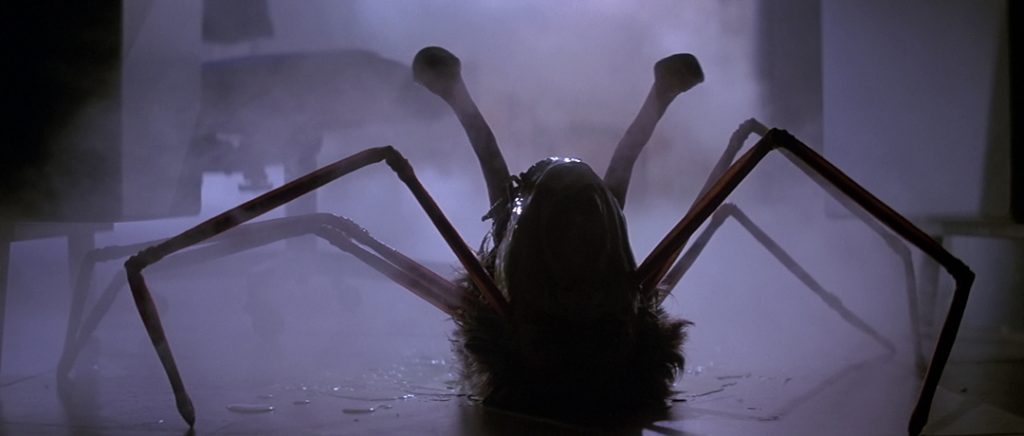
_ Rob Bottin's nightmareish spiderhead
This performance of confirmation reaches its apex in the infamous blood-test scene. After Norris’ head sprouts spider legs and scuttles off down the corridor before being bathed in flame, MacReady ties the remaining crew up — including the dead — reasoning that “every little piece is an individual animal, with a built-in desire to protect its own life.” If so, then blood itself becomes suspect.
His solution is more theatrical than scientific: each man draws blood into a petri dish, which MacReady duly ‘tests’ with a heated wire. MacReady as judge, jury, and executioner. This isn’t empirical; it’s ritual — a spectacle designed to restore order through show of strength. It is not proof they lack; there is no chance of that — it is the performance of it.
It is not just the brutality of the scene that is striking, but MacReady’s composure. Everyone is dehumanised now. When Clark — whom MacReady shot in the head moments earlier — is posthumously confirmed unassimilated, there is no visible remorse. Childs calls him a murderer. MacReady moves on.
Even the mechanics of the blood test expose its fragility. By MacReady’s own logic, the Thing should react the instant its blood is threatened. Why wait? Why reveal itself at all? Whether one reads this as simply a plot hole or not is beside the point. The illusion of control must hold — the performance is everything.
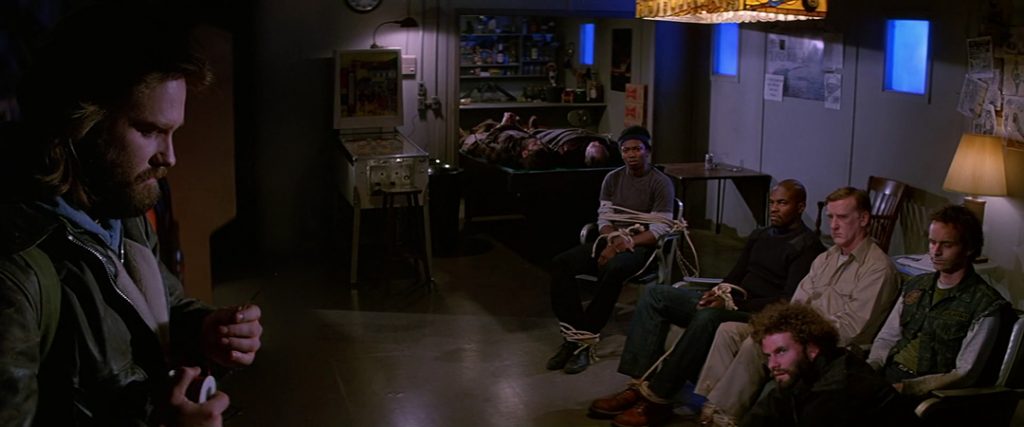
_ The blood test scene - everything's under control
The final scene crystallises the film’s sense of epistemological nihilism. Two men, MacReady and Childs, sit in the snow while everything burns around them. Neither they nor we can verify whether one or the other has been assimilated. Not checkmate this time, but stalemate.
And this lack of resolution is where we leave them: in the snow, suspended between truth and performance, unable to confirm the other’s humanity, or even their own. It is what renders MacReady’s earlier assertion — “I know I’m human” — worthy of scepticism. The statement is less proof than posture. In an all-male research station built on hierarchy and competence, certainty becomes a performance of dominance rather than a guarantee of truth. In an era of increasingly grotesque false narratives, social media strongmen, and deepfake-saturated feeds, such confidence feels theatrical rather than persuasive. In our hyperreal culture — where imitation is indistinguishable from the real and often preferred — authority defaults to whoever has the loudest voice. Carpenter’s final image hangs heavy. Perhaps the most unsettling possibility is not that the Thing survived, but that we would have no reliable means of recognising it if it had.
“Why don’t we wait here a little while and see what happens?”
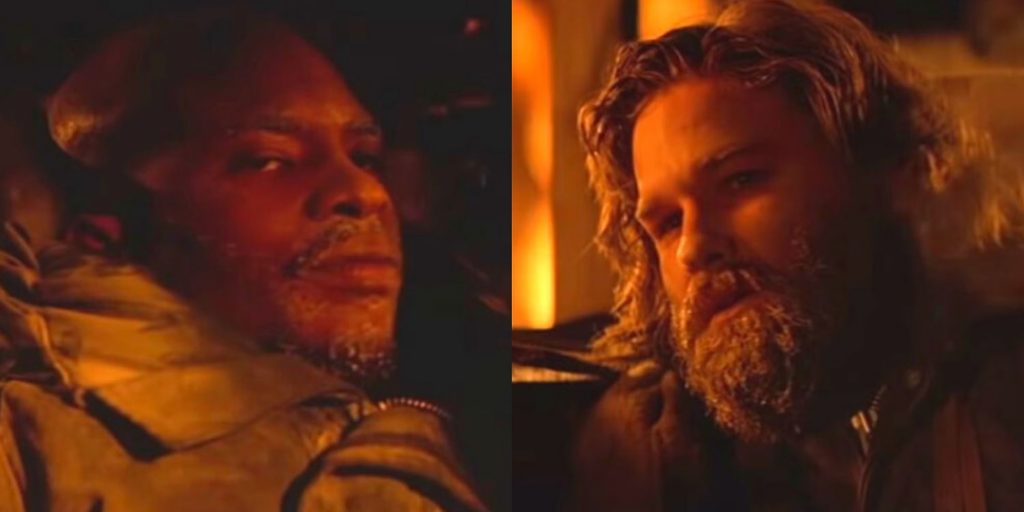
_ the scene that spawned a thousand youtube vids