Author Archives: Jammo

The Thing – I know I’m Human
Read Time: 8 mins

Film: The Thing (1982)
Director: John Carpenter
Starring: Kurt Russell, Keith David, Wilford Brimley, T.K. Carter, David Clennon, Richard Dysart, Charles Hallahan, Peter Maloney, Richard Masur, Donald Moffat, Joel Polis, Thomas Waites
Soundtrack: Ennio Morricone
Genre: Sci-Fi, Horror, Body Horror

Over forty years since its theatrical release, John Carpenter’s Antarctic elegy to paranoia and social atomisation feels less like fiction than an omen. In our post-truth moment, Kurt Russell’s MacReady proclaiming “I know I’m human” feels fundamentally unverifiable. The film is haunted by suspicion and by the instability of truth itself. Though undeniably shaped by Cold War anxiety, The Thing now feels less historical than diagnostic, holding up a mirror to our own world of kayfabe logic, where the truth must be performed and tested.
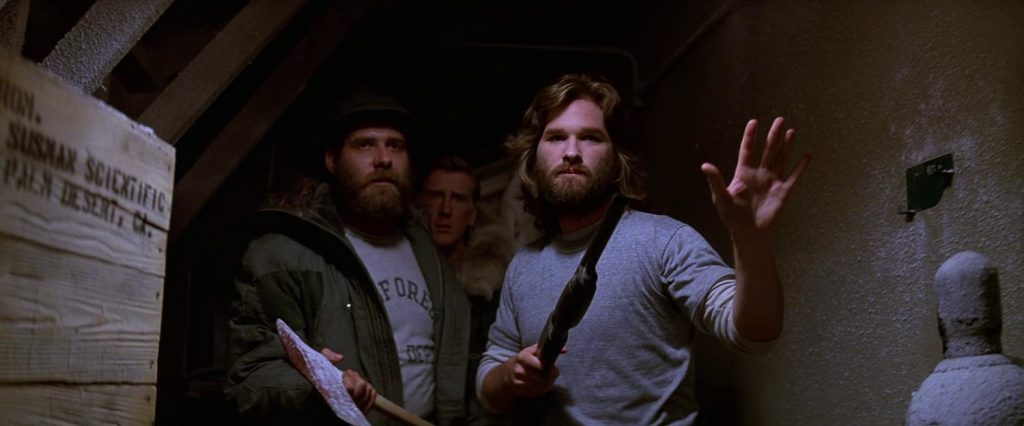
_ Fun in the dog house

Originally released in 1982, The Thing — a reimagining of 1951’s The Thing from Another World and John W. Campbell’s novella Who Goes There? — was, by all accounts, both a critical and box office failure. It’s rare to see a film travel from “the most hated film of all time” (Cinefantastique) and “disappointing” (Roger Ebert) to being routinely cited as one of the greatest science-fiction horror films ever made, which it is, obviously.

It’s been a tempestuous few weeks here. Floods, gales, closed motorways — an unwanted lockdown flashback, only this time in a much, much smaller flat. Confined to bed, some mystery virus coursing through my veins, it seemed as good a time as any to load up the DVD player, open a jotter, and add my voice to the ever-growing chorus of podgy middle-aged men on the internet insisting that Jon Carpenter’s The Thing is indeed a cultural masterpiece.

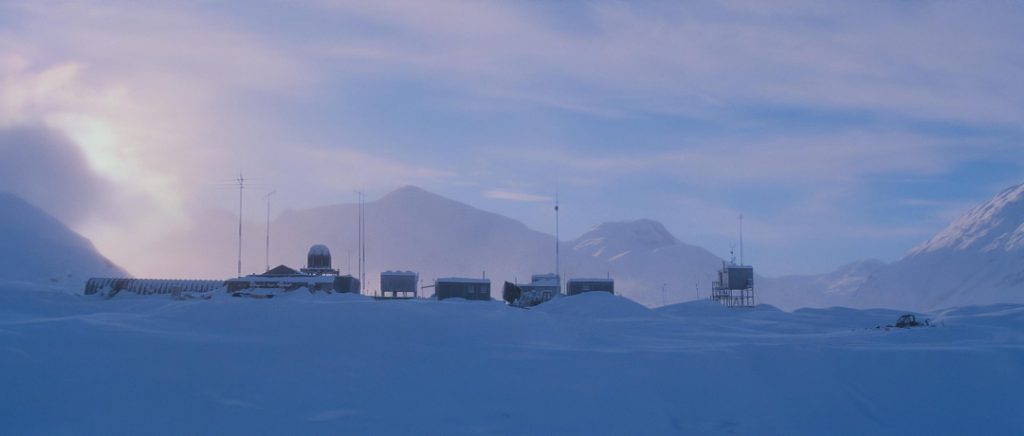
Before we reach the Antarctic research station, Carpenter presents us with a sequence of disorienting images: ominous synths drone as a UFO hurtles toward Earth, burning up in the atmosphere, ushering in a single staccato synthesised bass note as we open onto a vast glacial wilderness. A Norwegian helicopter appears to be hunting one of the most beautiful wolfhounds ever to grace celluloid (RIP, goodboy Jed, 1977–1995). What cruelty is this? Who could do such a thing? From the outset, Carpenter encodes the film with confusion, paranoia, and icy detachment, while Ennio Morricone’s soundtrack sharpens the tension — a score so effective it’s hard to believe it once won a Razzie. The tension escalates further as the wolf finally reaches the research station, the helicopter crashes, and the Norwegian’s warning — screamed in Norwegian, of course — is cut short along with his life by Garry’s gunfire.
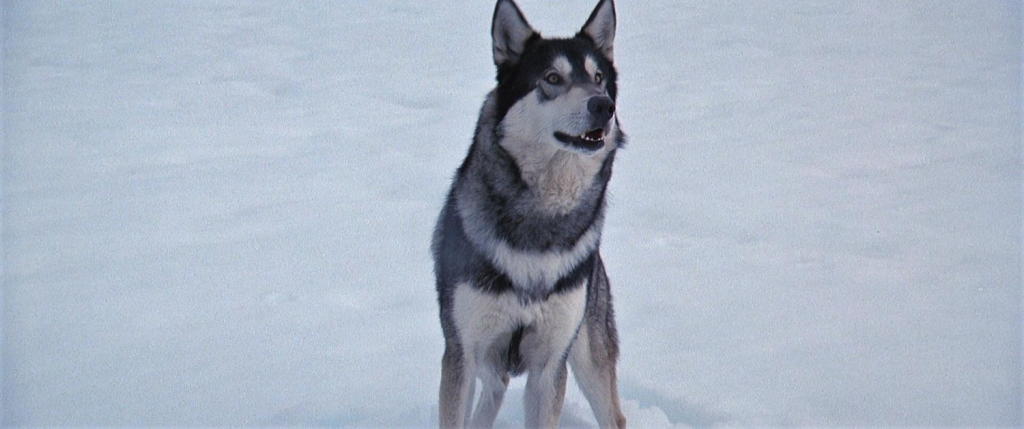
_ Goodest boy, Jed (also star of White Fang)

This sense of mistrust, miscommunication and foreboding is the spinal fluid running through the film’s core. Like The Shining before it, the cold and desolation do much of the psychological legwork. The characters — none of whom seem to be friends, and all of whom are male — are enclaved in this polar outpost. A place detached from everything, where nothing is real, and prerecorded game shows serve as entertainment. Where isolation amplifies suspicion and hierarchies ossify.

And into this ring of male ego and emotional detachment steps pilot R. J. MacReady, armed only with a sombrero, a bad attitude, and a helicopter licence — a man so cocksure that, when checkmated by the autonomous chess computer, Chess Wizard (coincidentally the only female presence in the entire film), his response is to pour a glass of whisky into its disk drive before calling it a “cheating bitch” — hardly boyfriend material.
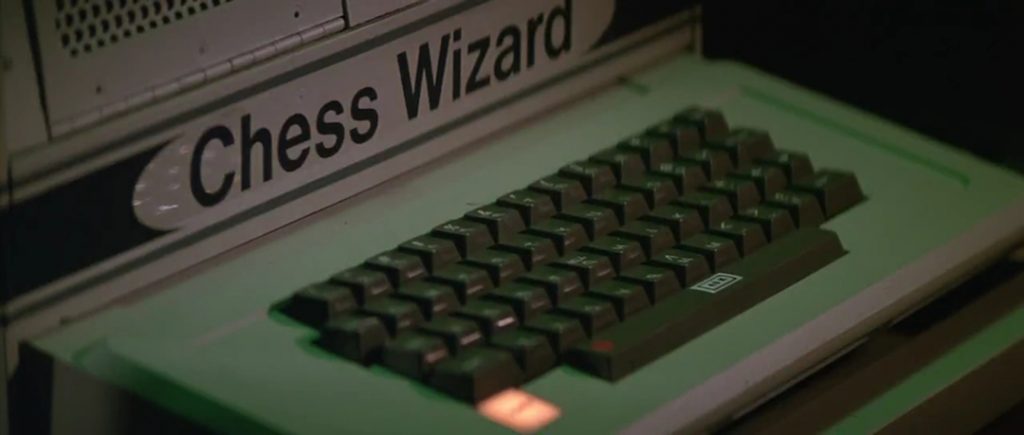
_ "Cheatin' Bitch!"

This is a world where selfhood is precarious, where even the smallest tell can spark suspicion, where evil is essentially viral. Though the film oozes with utterly nauseating practical effects courtesy of Rob Bottin, we never truly witness the Thing in its essence; we only see its process, it’s a happening, not a Thing, and that is where the true horror lies. As in Lovecraftian horror, Carpenter never fully reveals the monster. Yes, we know it can mimic lifeforms down to the last cell; we see the viral modelling on Blair’s monitor, but we are never granted confirmation of how deep that mimicry truly goes. There are clues that it runs very deep indeed.
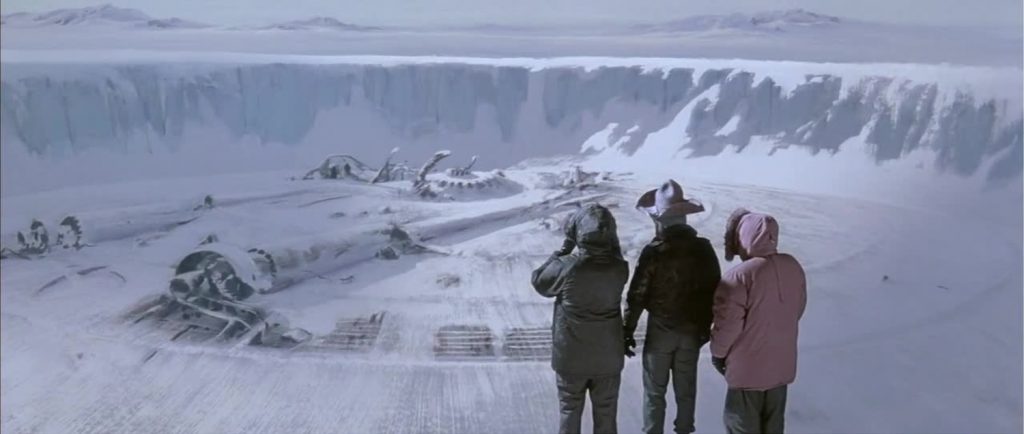
_ The original crash site

For example, toward the end of the film, what remains of the crew discovers a partially built spacecraft buried beneath the shack that has become Blair’s prison. By this point, it is clear that the microbiologist has long since been assimilated. Still, his sudden ability to construct a functioning escape vehicle suggests something even more disturbing: the Thing does not merely replicate — it remembers. If so, then Blair is no longer simply some evil alien; he is an accumulation — alien intelligence layered with wolfdog instinct, Norwegian expeditionary knowledge, human scientific expertise, and who knows what else. Does Blair even know he has been assimilated? Is the alien that initially crashed even the original monster or just another victim?

_ Trip to the Norwegian Camp

In the harsh tungsten light of the research outpost, we are condemned to question everything, including ourselves. Faced with this reality wobble, MacReady does what strongmen like MacReady do: he tells a story. Not to himself, but to the others — a narrative delivered as fact. 

When Childs asks: 

“So, how do we know who’s human? If I was an imitation, a perfect imitation, how would you know if it was really me?” 

MacReady responds with certainty: 

“I know I’m human… If you were all these things, then you’d just attack me right now… This thing doesn’t want to show itself; it wants to hide inside an imitation.”

A persuasive argument, perhaps — certainly the others seem convinced. But it is nothing more than bluster: a performance of authority even when all evidence points to the contrary. We already know the Thing can be anything in that room. The horror is not that MacReady might be wrong; it is that he has no way of knowing whether he is right. But he asserts it anyway. His worldview cannot entertain uncertainty — and the group responds in kind. This reflex toward dominance has them following his lead, even when he is no more justified here than he was when accusing the chess computer of cheating. Control must be asserted, even if everything else goes up in flames.
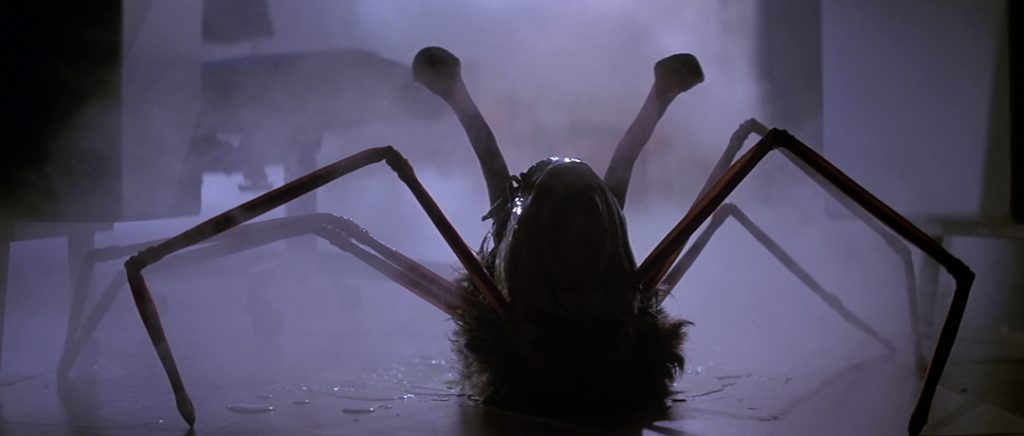
_ Rob Bottin's nightmareish spiderhead

This performance of confirmation reaches its apex in the infamous blood-test scene. After Norris’ head sprouts spider legs and scuttles off down the corridor before being bathed in flame, MacReady ties the remaining crew up — including the dead — reasoning that “every little piece is an individual animal, with a built-in desire to protect its own life.” If so, then blood itself becomes suspect.

His solution is more theatrical than scientific: each man draws blood into a petri dish, which MacReady duly ‘tests’ with a heated wire. MacReady as judge, jury, and executioner. This isn’t empirical; it’s ritual — a spectacle designed to restore order through show of strength. It is not proof they lack; there is no chance of that — it is the performance of it.

It is not just the brutality of the scene that is striking, but MacReady’s composure. Everyone is dehumanised now. When Clark — whom MacReady shot in the head moments earlier — is posthumously confirmed unassimilated, there is no visible remorse. Childs calls him a murderer. MacReady moves on.

Even the mechanics of the blood test expose its fragility. By MacReady’s own logic, the Thing should react the instant its blood is threatened. Why wait? Why reveal itself at all? Whether one reads this as simply a plot hole or not is beside the point. The illusion of control must hold — the performance is everything. 
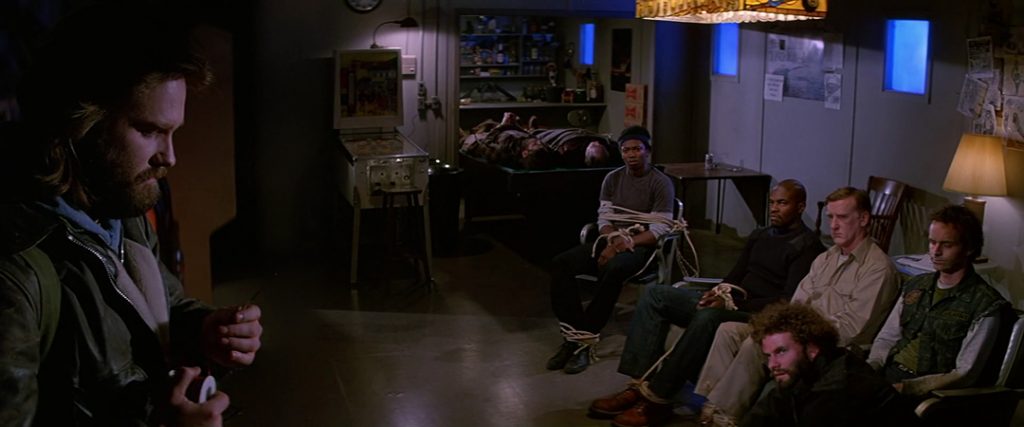
_ The blood test scene - everything's under control

The final scene crystallises the film’s sense of epistemological nihilism. Two men, MacReady and Childs, sit in the snow while everything burns around them. Neither they nor we can verify whether one or the other has been assimilated. Not checkmate this time, but stalemate.

And this lack of resolution is where we leave them: in the snow, suspended between truth and performance, unable to confirm the other’s humanity, or even their own. It is what renders MacReady’s earlier assertion — “I know I’m human” — worthy of scepticism. The statement is less proof than posture. In an all-male research station built on hierarchy and competence, certainty becomes a performance of dominance rather than a guarantee of truth. In an era of increasingly grotesque false narratives, social media strongmen, and deepfake-saturated feeds, such confidence feels theatrical rather than persuasive. In our hyperreal culture — where imitation is indistinguishable from the real and often preferred — authority defaults to whoever has the loudest voice. Carpenter’s final image hangs heavy. Perhaps the most unsettling possibility is not that the Thing survived, but that we would have no reliable means of recognising it if it had.

“Why don’t we wait here a little while and see what happens?”
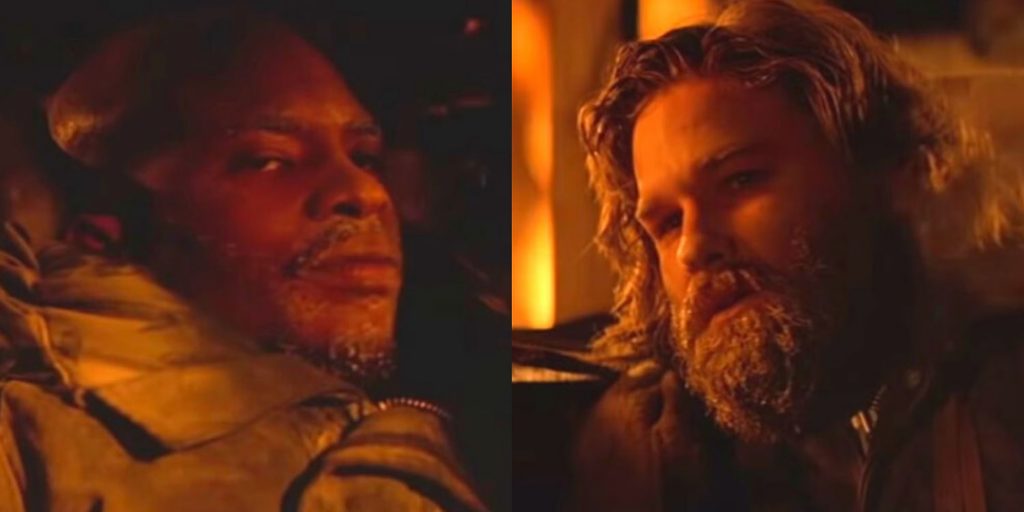
_ the scene that spawned a thousand youtube vids
+ POLITE NOTICE + + THANK YOU +

Don't miss the Fuzzy Frontiers monthly Digest

Helena Hauff – Yoyaku Instore Session

It’s been a complicated few weeks; I don’t get as much time as I’d like to listen to music at the moment. That said, I’ve been fixing some small code issues on the site today and enjoying this mix from Helena Hauff. Some lovely bits on here mixed deftly by a brilliant DJ. What more can you ask?

+ POLITE NOTICE + + THANK YOU +

Don't miss the Fuzzy Frontiers monthly Digest

Fuzzy Frontiers Albums of 2025

Read Time: 6 mins

It’s been a complicated year, hasn’t it? I’m growing tired of saying that, to be honest. It feels as if the walls are forever closing in: more war, more financial insecurity, more tyrants, more tech barons and and and. It’s like standing knee-deep in someone else’s excrement. It can be really tough to keep it together, especially when faced with multiple crises, both at home and abroad.

But just like J.M. Silk said, “Music is the key for you and me to unlock the mind.” And this year, it truly has been that — a lifeline, an off-switch. And so here’s part one of my favourite albums of 2025: the records that soundtracked this year, offered solace, and carried me through. Onward…

Cerys Hafana – Angel

After swapping the battleship-grey streets of Berlin for the verdant mountains of northern Portugal, this album of melancholic, harp-driven Cymraeg folk quickly became my daily soundtrack. Not since Peter Auty belted out Walking in the Air in The Snowman has anything made me cry this much.

Carol Mynyddog, in particular, is agonisingly beautiful. I still can’t listen to it all the way through without sobbing uncontrollably. It’s a portal to Ceredigion, with the saudade dialled up to 11. I close my eyes, and I’m transported to the west coast of Cymru: watching birds of prey with my granddad, playing in the River Leri with my brother, traversing the peaks of Talybont as a bored, spotty goth. It’s pure magic.

Elijah Minnelli – Clams as a Main Meal

I’ve been a fan of Elijah Minnelli’s home-brew distillation of cumbia, psyche, folk, and dub for years now, and Clams as a Main Meal has only ossified my fandom. Barbadian-British dub innovator Dennis Bovell guests on the opening track, Canaan Land, a journeying Nyabinghi-esque incantation that sets the tone beautifully.

The Cymru-core thread continues with a touch of Dwb Cymraeg in the form of Donna Donna (Chwerthin), featuring Welsh music legend Carwyn Ellis of Colorama. It’s tough to pick a favourite from Clams as a Main Meal, but at gunpoint I’d have to choose Watercraft Apologist: a world of long accordion refrains and mutated vocals looming darkly over the percussion and jaw harp, like a tawny owl locking onto its prey.

Pulp – More

Back in the mid-90s, when my friends and I were shoplifting ladies’ pinstripe trousers from the Aberystwyth branch of N** L*** (I was skinnier back then), it was widely accepted that guitar music was split into two binary camps: Blur or Oasis. A ridiculous choice, especially when we had Super Furry Animals and Gorky’s Zygotic Mynci at home. But even within the supposed battle for English music, the obvious winner was Pulp.

No one else embodied the mainstream strangeness of British culture quite like they did: the doggers, the reprobates, the boy racers, the pukka pie munchers, and the out-and-out perverts.

In a year that has functioned like some awful millennial fever dream, with all the worst bands returning for one final, bill-paying hoorah, having a new Pulp record has been comforting in the extreme. They are, as they always were, the perfect antidote to Britpop.

Perhaps it’s just that I’m knocking on a bit, but More doesn’t feel like something retro beamed in for the beer boys — at least not to me. It continues the Pulp canon rather than embalming it. Spike Island, however, is classic Pulp: deftly merging disco elements with self-effacing pop and a big chorus, a Pulp refresher, maybe.

The standouts, for me, are the Scott Walker-infected Tina; Jarvis declaring his unrequited love for a girl he’s only seen in passing, dreaming of “screwing in a charity shop, on top of black bin bags, full of donations that smell of digestive biscuits in the air”; and the final track, A Sunset — a lovely, stripped-back, country-esque rumination on digital life, social media, and late-stage capitalism. It also contains my favourite line on the album: “So now I’m learning about money, And I’m learning about law, The first rule of economics: Unhappy people, they spend more”

Various Artists – A Love from Outer Space

I suppose it’s normal that, as you age, your life becomes a laundry list of regrets — mine does, anyway. One of those regrets (among many) is that somewhere in 2016, I lost a battle against my crippling anxiety and didn’t go as planned to see ALFOS play in Berlin, while Andrew Weatherall still walked this dimensional plane. It’s safe to say I am a fan. I have a folder full of ripped versions of every set I’ve found online; I’ve even gone so far as to record some to tape — you know, for that vintage feel.

Sean Johnston and Andrew Weatherall pioneered a kind of dance music that was funky, dark, spiritual, and entrancing — a sound that was distinctly theirs, and at my favourite tempo too. And although Weatherall is sadly no longer with us, Sean Johnston has done a lovely job of honouring and carrying forward the sound the two embraced, from the pulsing, dubbed-out acid of Johnny Sender’s Zhivago Zhivago and the tribalist chug of Feon’s Round Earther, to the sleazy indie disco of Popular Tyre & Fats McCourt’s Feel Like a Lazer Beam, and the spaced-out funk of Das Komplex’s remix of Jazxing’s Neu Nostalgia.

Panda Bear – Sinister Grift

To be honest, I largely shunned all guitar music for the decade that Animal Collective were mostly active, and so missed the Panda Bear boat entirely — until he collaborated with Sonic Boom a couple of years back (another great album). As a lifelong Beach Boys fan, I am awed by Panda Bear’s sweeping vocal harmonies and the way he meshes acoustic and synthetic instruments in his work.

What was initially a terrible start to the year (like every year in Berlin) was soon lifted with the release of Sinister Grift, which opens with the obviously Brian Wilson-inspired Praise. Its multitracked melodies spiral around a simple drumbeat and acoustic guitar vamps with joyous surf-pop abandon. During February and March this was a genuine lifesaver during my cold and solitary dog walks across a below-freezing Tempelhofer Feld.

+ POLITE NOTICE + + THANK YOU +

Don't miss the Fuzzy Frontiers monthly Digest

5 Tewns Vol.15

Read Time: 2 mins

Hiya! It’s been a pretty low week over here—a sense of impending doom hangs in the air. Pre-Christmas blues? Who knows, but as Albert Ayler said, music is the healing force of the universe, so here are my top five tewns for this deflated December week.

Natural Magic – Don’t Look Back

Only heard this one today, but by God it’s beautiful. Boundless psychedelic music for the soul — a world of low-riding organs, Rhodes flourishes, and enormous, holier-than-thou fuzz-soaked guitar scales that could summon the ghost of Mick Ronson.

Al Wootton – Glorias

Musical polymath Al Wootton returns with a transcendent piece of organic techno, paying homage to the International Brigades of the Spanish Civil War. Built from samples of exiled composers, it’s fractured, emotive, and — in this age of trigger-happy militarism and neofascism — painfully, powerfully relevant.

The Black Dog –
Sleep Deprivation 40: Hypnagogic Sideboard Echoes

Soft, dulcet ambience from The Black Dog’s latest instalment in their Sleep Deprivation series. The spacing is perfection; the washes, the felt-coated pads, the distant conversations drifting in like half-remembered dreams. This has been my staring at the fog-covered mountains track for the past couple of days now. Headphones recommended.

Godspeed You! Black Emperor – 09-15-00

Speaking of headphones, I’ve spent a lot of time with them on this week. It’s been a pretty introspective one, truth be told, and naturally, that’s meant pulling out the Godspeed You! Black Emperor albums again. I’ve been especially glued to their anti–”multinational corporate oligarchy” record Yanqui U.X.O. Words can’t really express how deeply I lose myself in this one.

Talking Heads – (Nothing but) Flowers

David Byrne did a lovely version of this environmentalist, highlife-inspired track from the band’s ’88 Naked album on Tiny Desk the other week, and I’ve been playing it non-stop ever since. I love everything about it; the tight percussion, the serpentine bass, and David Byrne’s deadpan lilt: “And as things fell apart, nobody paid much attention.”

+ POLITE NOTICE + + THANK YOU +

Don't miss the Fuzzy Frontiers monthly Digest

5 Tewns Vol.14

Read Time: 3 mins

Bore da pawb! I’m in the beautiful city of Braga today. I’ve got a couple of holes in my shoes, it’s pissing down, and the Christmas music blaring through the town is so distorted you’d be forgiven for thinking you were at a Merzbow gig. Nothing, however, will shake my unrelenting love for Braga. We soldier on, there are more important things to worry about. It’s Bandcamp Friday, after all! So, for anyone that cares, here are my top tips for the week:

Elijah Minelli – Calopify Now!

Because I’m old and useless, I actually bought this record last week, completely forgetting about Bandcamp Friday. Nonetheless, the day is upon us, and I think you should buy this most excellent future-dub record.

Calopify Now! is a perfect example of what Elijah Minelli does so well: single-minded Farfisa-dub with roots in digi-dub, Jerry Dammers, and folklore. Its Harmonia-esque tones, ghostly wails, and deep bass make for an irresistible casserole of modern dub for these troubled days.

Semtek – Northern Lights (Wes Baggaley’s Northern Darkness Remix)

I’ve had this one for a couple of weeks now, but it’s out today — and it’s a belter. Wigan’s finest, Wes Baggaley, filters Semtek’s hypnotic Northern Lights through an industrial lens. It’s a lovely example of Baggaley’s worldview, where Godflesh sits comfortably alongside Gemini. It’s weird, metallic, and murky narcotic dance music at its finest.

The Necks – Ghost Net

Australia’s experimental music sorcerers, The Necks, return with their twentieth studio recording, released as part of a three-disc megapack. The longest piece, Ghost Net, my personal favourite, is a one-and-a-quarter-hour divination of mind-melting, drone-kissed, serpentine experimental jazz mastery. Sliding in and out of time like Sapphire & Steel, it’s a journey you’ll want to strap yourself in for.

Daisy Rickman – Where the Sun Meets the Sea

This one was actually released last winter solstice, but I’ve been listening to it weekly, if not more, for the past year. I’m making it part of my winter solstice rituals, and having just posted an essay about the Magic Atlantic, it would feel wrong not to include it here.

Weightless, deeply meditative guitar ambience from Kernow’s Daisy Rickman. Close your eyes, imagine yourself floating away from the lizard peninsula, southwest to Scilly, and follow the sun to the deep Atlantic. That’s what I’m doing anyway — it’s better than working.

CV Vision – Memory

Berlin-based space cadet CV Vision returns to Hamburg’s Bureau B with a collection of weird and wonderful psychedelic vignettes. A Memory sounds like the golden age of Italian film soundtracks, played on a rediscovered Sony Walkman in need of a cleaning tape. It’s warped, it’s hazy, it’s strangely romantic — and I bloody loves it.

+ POLITE NOTICE + + THANK YOU +

Don't miss the Fuzzy Frontiers monthly Digest

Atlantic Magic

Read Time: 9 mins

ghost-mist glides over river rush,
weathering rock to the cold Atlantic drop.
They move with Mountain energy,
the surge to converge.
Swallows glitch over a pylon’s buzz.
This place is alive.
It’s all around you.

She inhales; a spectral breath,
the distant motorway floods her mind.
She knows.
She is the river.
She is the transitsong.
She is everything.
The veil between worlds falls.
And this is the interface.

−··· ·−· · ·− − ···· ·

> ADVENTURES IN NATURE AND ANCESTOR WORSHIP

Like many people, I’ve had my fair share of mental-health issues: anxiety, burnout, depression and a lovely bout of agoraphobia after losing my job in a new country during the 2008 crash (Go capitalism!). Doom-think has shaped my internal monologue since I was about eleven. I probably didn’t help myself by fiddling with the serotonin valves like a bored cat at the kitchen tap.

On the flip side, I’ve always looked for ways to escape the gnostic dread of the so-called “real world.” I’ve tried everything from Zen and Transcendental Meditation to sweaty, ecstasy-soaked raves and squat parties — dissolving into a giant, pulsating human sponge, a collective oneness I can still feel in my bones.

I try to remain a staunch materialist, something like an open-minded atheist, but when my seven-year-old asks, “Is God real, Dad?” I never know what to say. How do you tell them no when you’ve met God, in the flesh, in a field outside Abingdon?

_ Last Known Location of God

> DIGGING IN THE DIRT

I was born in ’81, too young for acid house, but a veteran by the time grime and dubstep took hold. My generation were wannabe acid house heads: embarrassing smiley tees, flags-for-trousers, and a misplaced hauntological nostalgia for a moment glimpsed eight years prior on HTV news. We pieced together our history from worn-out tape packs and older heads recounting Castlemorton or Stonehenge. Children of the post–Criminal Justice Bill era. Old enough to watch Swampy dig his hole, but too young to go to Newbury.

_ Dreamscape 32: My all time favourite Tape Pack

We were true believers in the movement and its scattered ontology, shaped by resistance to suburban suffocation, the police, and capitalism itself — never to be lumped in with the consumer-led super-club sheep. Unity above all: we live as one family. Borders aren’t real.

We listened. We learned. And like our nomadic forbearers, we travelled from place to place in search of hardcore and jungle records of myth, playing them on beer-soaked turntables to uninterested West Country farmers’ sons who assumed we’d be serving up Sandstorm or Bullet in the Gun. We never did.

We were rooted in something older — a lineage that moves through Jamaican sound systems to Brixton, Bristol, Handsworth and beyond; through the discos of New York; into the warehouses of Detroit and Chicago. And, in my own personal cosmos, through the rites and rituals of paganism and druidism — used tentatively, but not without meaning.

After a while, rave history wasn’t enough. More travel was required. Like Sam Beckett, my friends and I spent long nights wormhole-hopping through sampology, moving backwards in time via 16-bit drum breaks: through the Billy Cobham nebula, the Meters belt, the Stax galaxy, and on toward the undisputed truth — an evocation of ancestral spirits; a single bass note plucked from the depths of the cold dark sea by Robbie Shakespeare; a snare drum ringing out in a converted Memphis cinema as we prayed. Looking back, this wormhole-hopping was its own kind of animism: time flattened, chopped, ancestors looped, returning.

_This is record lore.

_ Scott Bakula as Sam Beckett in Quantum Leap 

> THE INTERFACE

When I first met my best friend, Adman, in the dying days of the last millennium, it was at an old-skool jungle night in Oxford — Kenny Ken on the decks. During the usual cod-pill introductions, Adman lurched into a psychedelic sermon about vinyl: millions of years of plankton dying on the seabed, becoming oil, becoming plastic — summing up, vinyl records were literally our ancestors singing back to us. It took years for me to realise PVC is mostly made of salt, but in a way, the logic still holds. We are all matter, after all.

This concept of interconnectedness brings me enormous peace. The thought that my death will feed the earth in some way gives me a feeling of calm I’ve never found anywhere else. Anxiety has long been my mental co-pilot — always handy when I need reasons not to release music, put on events, write articles, or finish the comic I keep redrawing. In that context, this calm is goldwert.

I like to imagine parts of me ending up in trees, in mycelial networks, in a dog’s belly, or maybe as a grain of salt pressed into a vinyl record.

_This is the interface.

_ Examples of Atlantic Rock Art

> PLACE MEMORY

Recently, after a deeply miserable seventeen-year stint, I moved from Berlin to a small town in northern Portugal, and I’m shocked at how much joy this simple change has brought me. Growing up around Ceredigion and Kernow, among other less magical places, left me with a stubborn belief that the Atlantic is, in fact, magic. (Including the Irish Sea — don’t get petty.)

For years, this was just a feeling — some kind of felt knowledge lacking foundation. Then, a few years ago, I stumbled across the work of Portuguese archaeologist Joana Valdez-Tullet, specifically her 2019 thesis Design and Connectivity: the case of Atlantic Rock Art, in which she posits:

“The presence of shared practices across such widespread regions suggests the establishment of cultural relationships and consistent long-distance contacts during Prehistory.”

Valdez-Tullet argues that the Atlantic coast wasn’t so much a fringe of isolated peoples but something more like a network. Tides of ideas and symbols flowing like Awen. People travelled. Meaning travelled. A striking prehistoric model of connectivity that isn’t about borders or bloodlines, but about shared practices carried across water — a kind of cultural animism carved into stone.

Her work focuses on Portugal, Galicia, parts of Ireland, Scotland, and England, but the idea of an Atlantic network resonated far beyond her sample regions for me. It suggested, if only in my mind, a possibility I’d always felt: that Cymru, Kernow, Alba, Éire, Breizh, and Galiza might share deep echoes of a cultural language shaped by the ocean itself. I feel it in the valleys and mountains here, the rugged coastline of northern Portugal, the Lizard Peninsula, and my beloved Ceredigion. Though I’ve never been to Galiza, Alba, Breizh, or Éire, I imagine I would feel the same. This is a place memory.


_This is Atlantic lore.

_ The Magic Atlantic, somewhere between Mindelo and Vila Chã

> EVERYTHING TOUCHES EVERYTHING

Through rave culture, record collecting, and nature worship, what I keep coming back to is that none of this needs to point toward some kind of techno-utopian dream or 8mm resurrection of the past. What I glean hope from is the way things touch: communities, ideas, sounds, people, and nature. Spirituality, for me, isn’t a lineage to preserve or a technology to master; it’s something lived in the cracks between material things — in the bassline that rattles your chest, in a mountain that feels like an old friend, in the small rituals that weave us together.

For me, nature worship isn’t so much a set of rituals or rules. I’m simply trying as best as I can to be present. Treating the rivers, mountains, coastlines, buzzing pylons as beings rather than scenery. A kind of everyday animism. And some ‘beings’ are more important to me than others. There is a tree in the centre of Tempelhofer Feld, Berlin named Sylvia, she is a friend, she is also my grandmother, she got me through lockdown. I take solace in the belief that the world isn’t made of objects but relationships, and that paying respect and transmitting it, is its own small ritual.

_ Sylvia looking stunning at sunrise // 52°28'25.5"N 13°24'47.2"E

I’m drawn to both Druidism and Paganism because they remind me that the world is relational — that meaning grows between things — and that life feels richer when you refuse to see nature and culture, matter and spirit, past and present as separate.

I focus on the Atlantic only because it’s the world I inhabit and understand. But this sense of animism, timelessness, haunting, and oneness echoes across countless cultures: the Ubuntu philosophy of the Bantu, the Kachina spirits of the Hopi, the personhood granted to rivers and mountains in Māori belief, the Kami of Shinto. The list could go on forever.

What survives — what remains — are the touchpoints:
a record groove cut into salt and oil;
a spiral pattern etched across the Atlantic;
phantom mist dancing on the river;
Or a moment of collective ecstasy dancing to Sweet Harmony in a dodgy old warehouse.

_Everything touches everything else.
// It’s all around you.

_ Ghost Dancers on the Tâmega

> BONUS LEVEL / FREE STWFF

Rooting around in a bunch of old tapes, WAVs, and bits and bobs, I found this demo of a little ditty called In-Between-Things-Demo, which I vaguely remember recording on a rainy day in Penryn, Kernow, around 2005, under the long-ignored moniker J. Niwl.

As we’re launching our Time Ghost imprint next year, and since it fits the mood of this article, I figured I’d put it up as Free / Pay What You Want on the Time Ghost Bandcamp.

There are a couple of similarly horizontal bits I’ll throw up there soon…

+ POLITE NOTICE + + THANK YOU +

Don't miss the Fuzzy Frontiers monthly Digest